
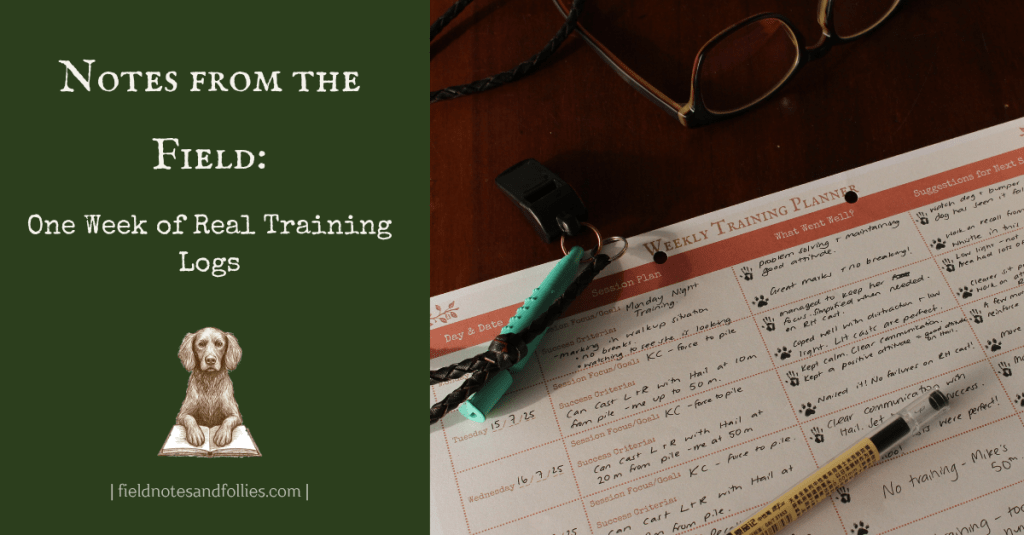
We’ve all been there. You start the week with the best of training intentions… and by Wednesday, the wheels have well and truly fallen off. You’re too tired, something else came up, the weather was awful, or you just didn’t have a plan and lost the motivation along the way. I totally get it. I’ve been there too! When my training started to come unstuck, I fell back onto what I’ve always found to be useful – writing things down.
So that’s what this post is all about – one handler, one dog, and one week of real training notes. This is an honest look at my last week of training – not a polished highlights reel. It’ll be rough and ready – just like real, in-the-moment training notes should be. I’ll discuss why I track a week of training sessions, and what that actually looks like as the week unfolds. I’ll also share some of the insights I gain about our training as the week progresses. Lastly, I’ll explain why it all matters.
Why Track a Week of Training?
Notes, although not especially sexy, are the best way to spot patterns in our training sessions. They give us the data we need to reflect, adapt and progress.
Originally, I started taking notes about my training sessions adlib. It was fine. Sure, it gave me a moment to reflect on what had happened in that session. But it felt like something was missing… or more to the point, it felt like there were things that I was missing. Think of it like dots I wasn’t able to join together – and that’s where weekly tracking really upped my training game!
Looking at training notes from a whole week has many benefits. I think it’s in part because you’re often focussing on one or two key skills each week. Looking at how those few skills have developed as the week plays out gives you a much clearer picture of if you’re heading in the right direction, or if you’re getting bogged down in the weeds of a particular skill.
Tracking a week of training also means that you actually think more intentionally about what you are going to train. Jumping from one skill to another, or trying to train ten skills each week, doesn’t do much for continuity or skill development. It’s also a quick way to burn out your motivation for training because it feels like you’re making invisible amounts of progress in a million different directions. Weekly tracking changes that. It means you think about one or two key areas you want to focus on, and you dedicate your time and efforts into those skills only. Ignore everything else. How’s that for essentialism in dog training?!
What it Actually Looks Like…

As you can see, my notes aren’t complicated and they don’t have to make sense to anyone else. That’s because they aren’t for anyone else. They’re for me, like your notes will be for you. You don’t need to write long reflections or structure it perfectly. Scribbles and short-hand are totally fine. The only rule is: write what helps you. Provided that you capture the best bits and the bits that need work, you’ll start to notice patterns.
For me and my weekly tracking, I note down things like the goal of the session and what success criteria I’m looking for to know that we’re nailing it. I also jot down what went well from my perspective as the handler and what I thought Hail did well too. I then make a few short notes on what we can work on in the next session. Nothing fancy. Nothing too involved.
As you can see from my notes (if you can read my chicken-scratch handwriting!), Hail had a few days where she really struggled to do a right-hand cast. I made a mention of it in my notes, and in the subsequent sessions I kept an eye on the behaviour. This is something I might not have noticed without taking the time to reflect on each session and looking at the sessions in sequence. As a result of the observation, I was able to adapt and simplify the right-hand cast for her by having her turn slightly to the right before each cast. Within a few days, the quirk was gone. Job done!
I’ve also been working away on a daily training log too. This is helping me to catch the finer details in my training sessions like the weather and the dog’s level of engagement and how I felt about the session.
Training Insights from Weeks of Tracking
Aside from the obvious patterns in the dogs behaviour, there are a few other things I’ve noticed as I’ve tracked the weeks.
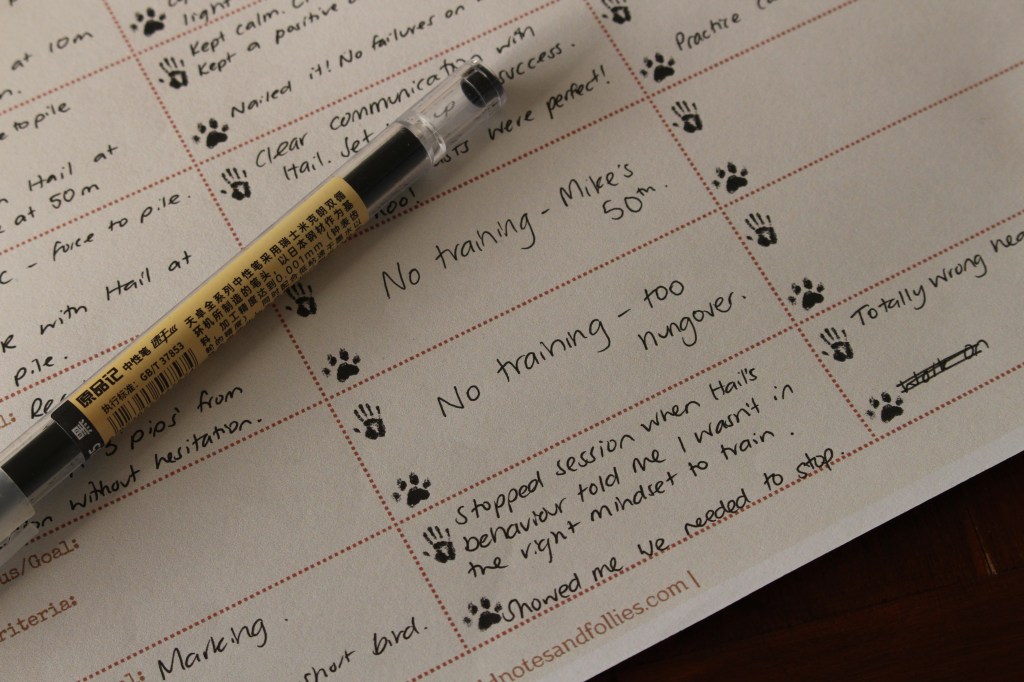
For one, I very rarely train every day of the week. It’s not that I don’t want to, or don’t plan to. It’s just that life happens – and that’s ok. As I’m now training more intentionally on the days that I do train, I’m getting more out of my sessions. Whether it’s three sessions or six, it’s the quality that counts. Each time I train I pick up where we left off (and I know this because I have my notes), so each session builds on the one before. We don’t repeat unless we have to, so we don’t stagnate. And weirdly, it’s reassuring. So even the messy weeks still count.
I’m also noticing that more of Hail’s mistakes in our sessions are because I have missed something. I find I’m getting less frustrated with her because I can now see where she was showing me she didn’t quite understand and I kept pushing the session. Or where I upped the level of distraction or distance too quickly and she wasn’t quite ready.
The weekly insights have also allowed me to let go of perfection. You will have noticed that my notes aren’t perfect. Despite being a teacher, I don’t have beautiful handwriting, and I often make spelling mistakes that I fix by crossing things out. I get that this will trigger some people – and that’s ok. I’m not after perfection; I’m after progress.
Why Tracking Matters

You can absolutely train a gundog, or any dog, without tracking your training in note form. And you can absolutely be a successful handler or trainer too.
For me, tracking matters because I don’t have the kind of brain that lets me keep all my dog training thoughts at the surface. Like many of you, I work full-time, I have other dogs to take care of, and I have a pretty active social life. All of that takes up mental capacity that means that I forget where I got up to in my last session. Tracking helps to keep me on task and moving in the right direction.
Having a record of my training sessions and being able to reflect has made me a better dog trainer. I speak more about this in a previous post, but without my notes, this would not be possible. As I’ve said before, I’m not trying to be perfect. And at the risk of sounding super corny, I’d like to be the best trainer that I can be. If taking a few quick notes about my training sessions allows me to do that, I’ll be writing notes with bells on!
So, what have you got to lose? Do you think that you’d benefit from tracking your next week of training sessions? What patterns might you see emerge? Try taking some notes. Whether its in the back of an old notebook, on a whiteboard or – when it’s ready – in the Field Notes & Follies Weekly Planner. Want to be the first to know when the Field Notes & Follies Weekly Planner is ready? Sign up on our home page here.
Try tracking your training for one week. You might be surprised by what you notice.
If this post resonated with you, let me know. I always enjoy hearing from others on the same path.






Leave a comment