
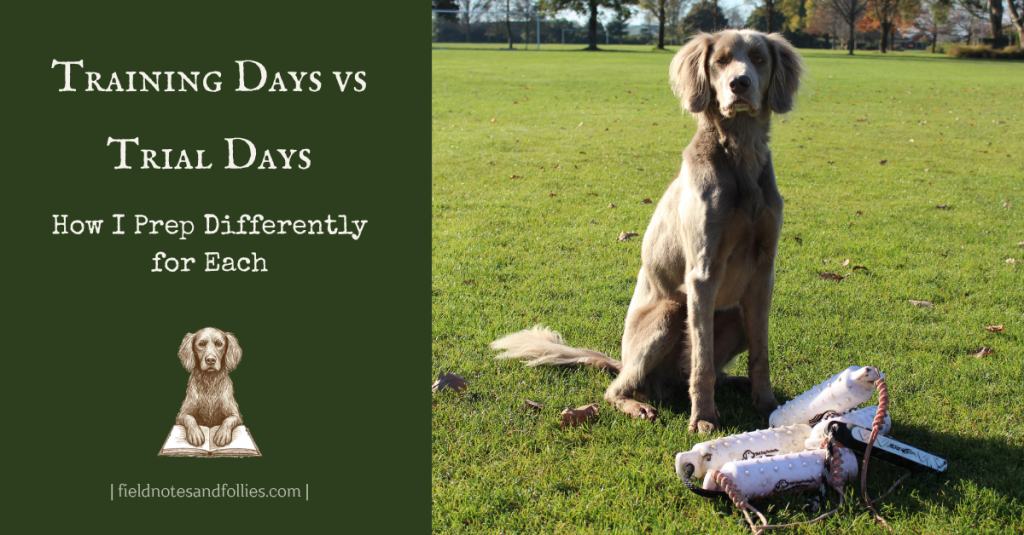
Those who train with me know that Hail is an exceptional mirror of my state of mind. When I’m good, she’s good… and when I’m not… well…
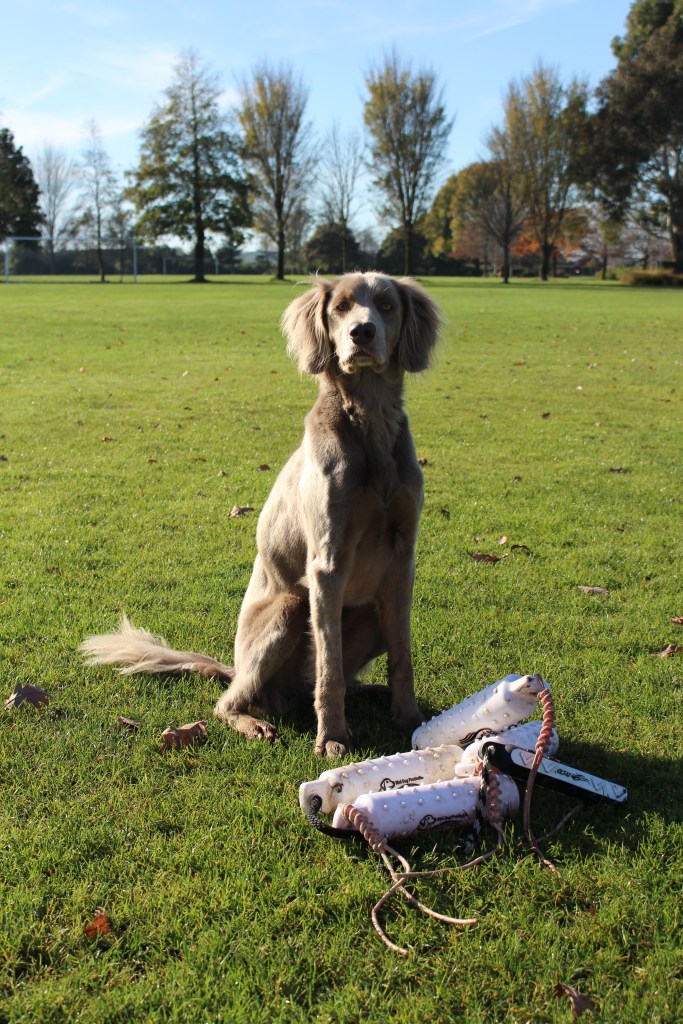
Weirdly enough, this isn’t something I really noticed much until recently. I’d been battling with a few of our gremlins (mainly some delivery woes but a bit of breaking at the peg had started to creep in too). Without realising it, these issues had started to play on my mind every time we turned up to a trial. Subconsciously, I started projecting my fear on to her… and guess what? It meant that we weren’t getting all our deliveries and Hail was breaking more than ever!
What was odd was this never seemed to happen on a training day. I couldn’t even trick her into breaking on a training day – not even with birds out of the launcher. And I’d get my deliveries, every single time! I couldn’t make sense of it – it was bloody frustrating.
After a few good yarns over a pint, I was able to see the situation more clearly. So, what was different? Turns out, it was me! It came down to how I showed up for the event.
As you will know, dogs are masters of understanding context. A training day is nothing like a trial day. And try as you might, it is almost impossible to recreate the atmosphere of one from the other. This got me thinking… “how can we get the most out of each environment?” – because they are both crucial for developing a well-rounded field dog.
They might not seem all that different at first glance, but each requires a different headspace and prep style. So this is my attempt at making sense of the differences between training days and trial days and how you can get the most out of both.
Mindset
As I’ve discussed in previous posts, mindset really can make or break how a day pans out. Here’s my take on how mindsets differ between a training day and a trial day.
Training Days
While it might seem obvious it can be hard to remember that training days are all about learning. A training day is the perfect opportunity to experiment a little. To try things out. You might stretch your dog a little more on the distance or difficulty of a skill they already know. You might even push yourself to give a different handling technique a try. Training days are the days to get curious about what would happen if you tried something different. It’s in those moments when we make mistakes that we learn. When mistakes happen we can use that valuable information to reflect, adapt and try again.
While training days should be a relatively ‘low pressure, low stakes’ type of environment, it’s still crucial that we are mentally prepared for them. I’m frightened to admit the number of times I’ve turned up to a training day and its gone terribly wrong because I didn’t take the time to get my head straight before turning up. It’s amazing how easily we can stack on our own pressure, especially if it’s a group training situation and you feel the need to ‘perform’. Some of my toughest training days were when I didn’t mentally prepare, my emotions snuck up on me and I got caught off guard – cue the tears… embarrassing!
For me, mental preparation looks like a few gentle reminders before I leave the house, and again, before I step out of the truck onto the grounds:
- Training days are about progress, not perfection.
- Egos get left at home.
- They are an opportunity to embrace failure for the deep learning it provides.
- They are an opportunity for me to work on my own skills like remaining calm when faced with challenges or keeping my frustration in check.
These simple reminders help to keep me in a calm and curious state of mind. This makes me more receptive to feedback, more gently critical of my own performance and help to keep things in perspective when they aren’t necessarily going my way.
Trial day
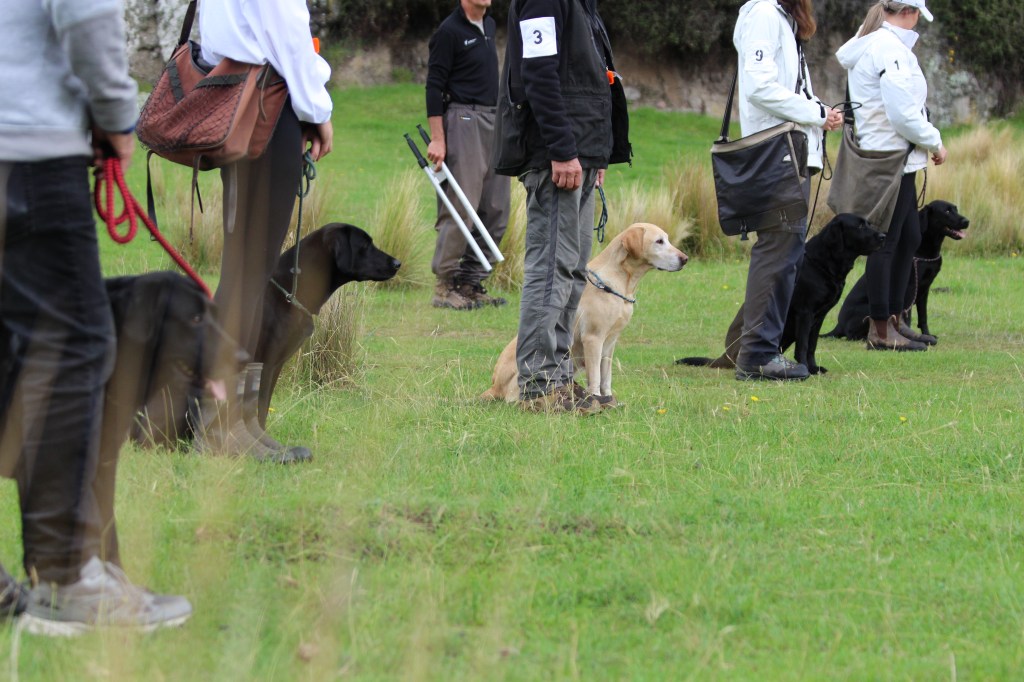
In contrast, a trial day is all about execution. You want to go into a trial feeling confident – something that comes with consistency of performance. Field trials are an opportunity to test all the skills you and your dog have been working on over the past few weeks or months.
Like any ‘test’, trials feel much more high stakes. I have to say, I’m not a particularly competitive person, but I still like to think I’ve done my best and represented myself well on the day. It’s a feeling that’s not all that easy to keep in check, especially when you have a four-legged teammate who has their own agenda too.
Trial performance has much more to do with the mindset of the handler than most people realise. You can have an exceptionally talented dog but if you don’t have your own nerves or thoughts in check, your mental state can drastically affect their ability to function. All that energy travels down the lead.
On trial day, confidence is key. This means that you want to stick to working the skills that you know your dog has mastered. This is not the time for trying new stuff on the fly. You also want to switch your mindset into ‘protect your headspace‘ mode. For me, this is a pretty active and physical process that involves things like:
- Moving away from other handlers and dogs to get some quiet time to reconnect with Hail.
- Taking a few deep breaths.
- Rubbing my hands together in circular motions – don’t ask why it helps, I don’t even know I’m doing it!
- Reminding myself that we aren’t playing for a row of houses, as my mum would say.
For you, it might look like listening to music or some other calming ritual you tend to do subconsciously when you’re a little bit heightened. Whatever it is, I’ve noticed that the best handlers have something that they do before stepping up to the peg that helps to ground them before the competition.
The good news is, the more I compete, the less the nerves seem to affect me. It’s taken me a few years to get there – and your journey might amble along at a different pace – but I don’t get as nervous when heading to the peg now. That’s probably a combination of Hail having a wider skill set and me getting to grips with the battle going on in my head.
I think the bottom line is, if you’re stepping up to the peg at a trial you can be pretty confident that you’ve done the work, so now it’s time to just do the job.
Systems & Preparation
Heard of the phrase “All the gear and no idea?”. The reverse is also equally frustrating. Having the right kit for the day can make a big difference to what you can achieve and your level of enjoyment.
Training Days
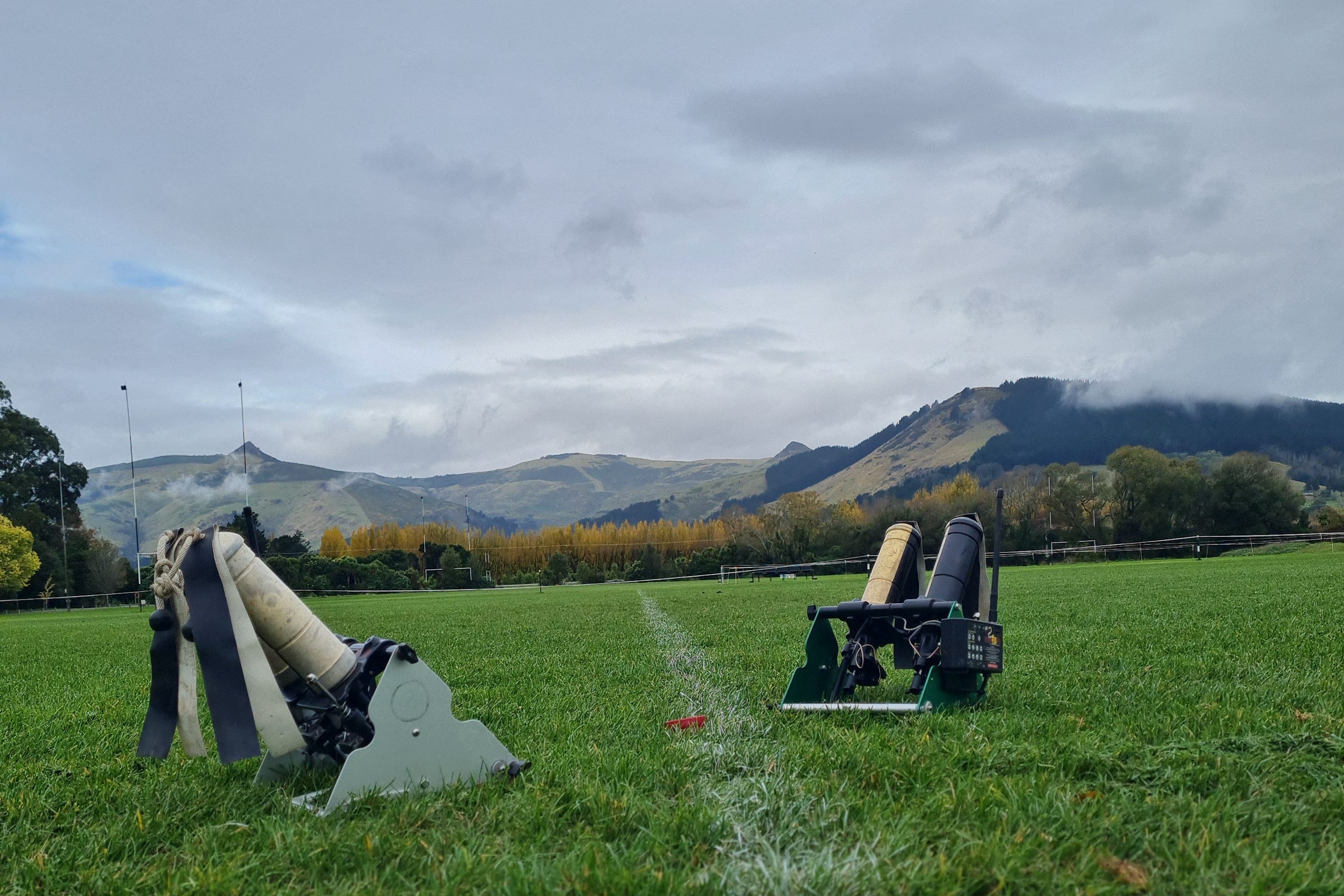
I’m going to be honest, my preparation for training days is pretty haphazard.
Most of my training gear lives in a revoltingly untidy heap on the back seat of my car – so I don’t often need to invest much time into loading the vehicle. That said, I do store my bumper boys and some other specialist equipment elsewhere. At a push I might have to throw in a few extra items, but the prep is very minimal. I think this speaks to the more relaxed nature of training days. They’re fairly flexible, so if I’ve made it out to a training ground and left something at home, I just adapt my training plan to work around my mistake.
Interestingly, I am a bit more of a stickler when it comes to having a plan for my training session plans. As regular readers will know, I need to have training notes to guide my sessions. I’m completely hopeless without a plan! This is the part of my training day prep that I can’t skip over. Before a training day or session, I will always refer back to my notes to see where I got up to and where I’m headed. I might also follow this up by reviewing any training program material online that is relevant as well. This just serves to refresh my mind on what’s most important.
As part of my weekly planning, I will also think about things such as the timing and location of my training sessions. I often train after work with my partner in one of a few local spots that are convenient for us. We each pick a skill or two that we want to work on, and we choose a location that meets both of our dogs needs. But, I also keep a space open at the weekend for training with friends, or training in more exotic locations that suit more ‘fieldwork’ type skills. Again, planned but flexible.
Trial Days
Trial days are a much more planned out affair.
Our prep for attending a field trial can start weeks in advance, depending on whether it’s a local trial or one we need to travel for. In New Zealand, most of our trials would span a whole weekend, sometimes a long weekend. They’re huge days, especially if our club is hosting. You spend all day out in the field helping out when you’re not running your dog.
In the case of travelling trials, we often need to book accommodation months out. Then there’s all the admin of organising all the gear that going away entails, so, for the purpose of this post, I’ll stick to talking about our prep for local trials.
When attending local trials, we usually start the preparation the week building up to the trial. We are firm believers in the idea that if you can prep it early, you should. Somethings can only be sorted the night before, but others can be done in the week leading up. This includes things like:
- Making sure you have packed all the right equipment for the weekend (see my post for a handy checklist you can use to help with this).
- Loading the car up with everything you need – best done the night before as trials often start early.
- Filling the car up with fuel.
- Getting the dogs dosed for sheep measles if required by the landowner.
- Putting a hearty dinner in the crock-pot for when you get home – Cooking, if you’re not intending to have dinner at the pub, is the last thing you’ll want to do when you get home – trust me!
While none of this is earth-shattering stuff, every little thing you can do before the day is going to help reduce your decision fatigue on the morning of. All of that equates to a calmer, more confident you leaving the house – a recipe for success at the peg.
Even thinking about the little things, like checking your travel times, packing your lunches or, sitting the thermos by the kettle help to ease the mental load first thing on trial morning when you’re bleary-eyed and still half asleep. Anything you can do ahead of time, do it! As I always say, “your future-self will thank you for it“.
Rhythms & Routines
Dog training can be a bit of an all-consuming beast at times… if you let it. Getting your rhythms and routines in order can really help to keep you in a state of flow when things get busy.
Training Days
As I’ve mentioned before, routines are an essentialists bread and butter. They provide clear structure, reduce decision fatigue and help to carve out time for the things you want to work on most.
The joy of training days is that you can schedule them in to whatever parts of your day work best for you. The flexibility of when the sessions take place, their duration, the location, and the skills you focus on all come down to you. Training days fit around your life. Bliss!
For us, we train after work (or at the weekends), our sessions are done in a few predictable locations, they’re normally between 10-20 minutes per dog – so in under an hour (including travel time) we have both Weims educated and exhausted without too much fuss. That leaves us plenty of time to walk the golden oldies at a time that suits us.
The adaptability of these sessions also mean that we can change things up if needs be. We all have off-days, our dogs included, and training days provide space to wiggle things if they aren’t quite working like you’d hoped. You can take breaks, simplify or have a few fun bumpers to recover attitude – whatever it takes to reach some level of success. All in all, the more relaxed energy of training days is a breeding ground for progress.
Trial Days
Field trials are a bit more of a fickle mistress. There is a schedule to stick to; early mornings, travel times, and running orders. There can be lots of down-time, or time between runs where your flat off your feet launching birds, penciling for the judge or setting up the next course. When do you toilet your dog? When can you get back to the car and let them stretch their legs? All important things to have given a bit of thought to. Not to mention how are you going to take care of yourself during the day? When’s a good time for lunch, to reapply sunscreen, to go to the loo?!
Additionally, there can be long waits between when you thought you were up for your turn and when you actually make it to the peg. This can be a really challenging time, especially for inexperienced dogs. They can get themselves all sorts of fizzed up, so you need to have a plan for how you might manage that.
And then, the main event! You get one opportunity to do your thing and then it’s all over in about 10 minutes.
Some of this stuff happens on the fly, you take your moments when you can. But other aspects do require a bit of thought and planning. A good rhythm builds confidence in you and keeps your dog fresh.
How They Work Together
In short, training days build the skills, and trials put them to the test.
Training days are your chance to experiment, and trial days are you opportunity to execute.
Their purposes are different, and each should be treated as an integral part of a well-oiled gundog training routine. If you only ever train, you have no yardstick by which to measure your dogs true ability to function as a working dog. And, if you only trial, you will struggle to develop the skills you aim to achieve at more than a surface level. You would be riding on genetic ability alone.
Do you agree? Do you train the same as you trial? Or are you like me, and a firm believer that both are necessary for a well-rounded field companion?
Let me know what you think in the comments. It’s always great to hear from fellow trainers.



 Field Notes & Follies
Leave a comment