
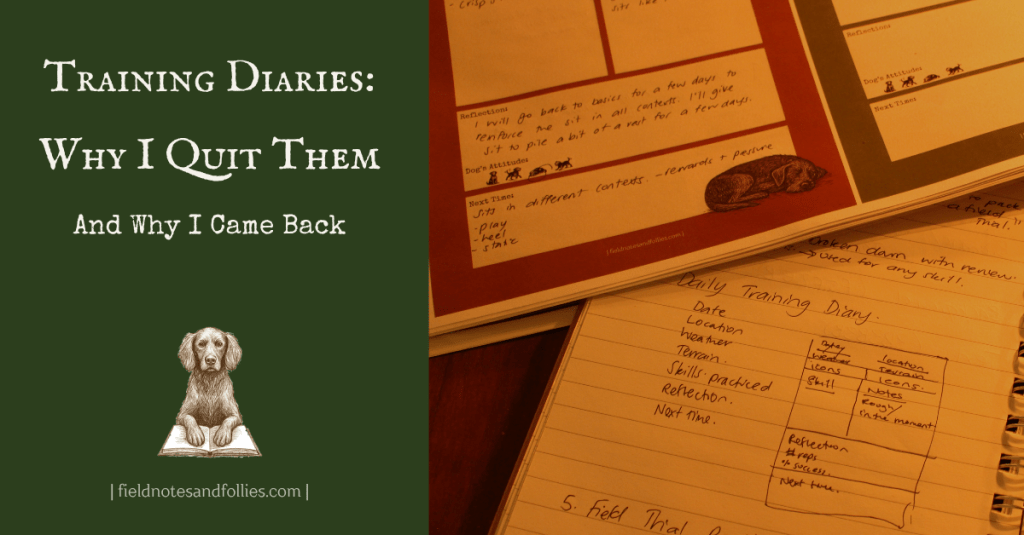
It all starts with the best of intentions – a bit like a New Years resolution. You go out and buy that pristine new journal with the ambition of writing in it every day. You glamourise the thought of being one of ‘those’ people who keep a thoughtful and detailed training diary that’s also an aesthetic beauty to behold. The reality… somewhat lack-lustre. What you end up with is a scrappy, dog-eared notebook full of illegible scribbles that is anything but inspiring. In fact, if you’re anything like me, you’re so ashamed of the state of your diary, and it’s pitiful contents, that you just tell people you don’t keep training notes… oh the shame!

But I promise, it doesn’t have to be like this. I am now the proud owner of a training diary, but it’s nothing like the one I used to keep. So, I thought I’d share my experience and transformation into an avid training diary keeper, in the hopes that it encourages at least one person to give them a crack, too.
Why I Quit Keeping Training Diaries
Anyone who’s tried (and failed) at keeping any sort of journal can probably relate to my list of reasons why I stopped keeping a training diary.
I think one of the biggest barriers for me was finding a layout that worked. As we all know, dog training is a deeply personal thing. Every handler has their own approach to training, and every dog we train will have different challenges that we want to document. Traditional journals or diaries don’t have enough flexibility to add or removed sections easily depending on what you’re working on. I don’t know about you, but I often need a raft of different sections or page layouts. Sometimes I want to write a detailed account of a particular session, other times I want to look at a week overview, and sometimes I want a simple tracker for a specific behaviour. These can be really time consuming to recreate by hand on every page. Premade planners are a nice idea but they can be very prescriptive. I’ve also found that premade planners are almost never made by people who actually train dogs, so the contents can be a bit hit and miss.
Additionally, I’m not the most creatively talented person out there and I found the idea of making my own layouts a little bit daunting. A quick search on YouTube had me completely overwhelmed as even a ‘basic’ tutorial on how to set up a planner looked like it required a degree in fine arts. It seems silly, but even if I’m the only person that ever sees it, I still want my training diary to be something I can be proud of.
Another barrier to me keeping a training diary was that it just seemed like one more thing I had to do after each training session. I think this in part may have been a reflection of my headspace on life at the time, but I can totally relate to that feeling of hurry sickness. Working full-time, training dogs, trying to maintain a social life, while still managing to exercise and get eight hours of sleep a night – there just isn’t a lot of time left for filling in a training diary!
And that brings me to my next issue… knowing what to write. Staring at a blank page is daunting… and I like writing! When you’re in the depths of struggling through a dog training problem, the last thing you can think about is how to put it into words. Most of the time it takes all of your mental capacity to even be able to pinpoint the problem. And then you have to work towards a solution. Sitting in the car, pen in hand, almost in tears when things aren’t going well is too much to handle at times. And having to document that without a clue where to start was the straw that broke the camels back.
I guess what I’m saying is that a poorly constructed training diary can very quickly lead to burnout. And this burnout doesn’t just affect the diary, it changes the way we feel about the training too. I’d get so stressed out about what I was going to put in my journal that I’d psych myself out of training altogether some days. Silly, I know, but it was the reality of my experience.
Why I Came Back to Training Diaries
You might then ask, “why the bloody hell did you want to keep a training diary again?“. Great question!
In truth, I came back to training diaries because I had to, not because I really wanted to. What I mean is, I needed to keep a training diary. I love the saying, “what you focus on flourishes”. This is what I knew a training diary would help me to do. I just hadn’t found a rhythm or a system that had worked for me… yet.
You may have seen my previous post about the moment that I knew my training was floundering but I couldn’t explain why. That really sums up why I knew I had to try and make friends with some sort of training journal again. I knew that if I wanted to get better at my craft I needed to be able to document what was working and what wasn’t. Filming sessions is fine, but it is time consuming, takes up too much space on my phone and often doesn’t force me to reflect in the same way that writing things down does.
A training diary also gives me something to look back on. On those dark days, when things really aren’t going your way, it can be nice to flick back and see that you’ve overcome hard things before. It gives you hope that you can do it again and also serves as a reminder of how far you’ve already come.
Written notes, especially if they follow the same format, also highlight patterns in your handling performance and your dogs performance at a glance. These can be good patterns, or those sneaky bad habits that creep in without us noticing. It might be that you always train in the same location, or that in the last month your puppy has had fewer accidents inside because you’ve changed up your routine to suit them. Identifying patterns is what dog training is all about. In my opinion, training journals are the best tool for this.
What I Do Differently Now
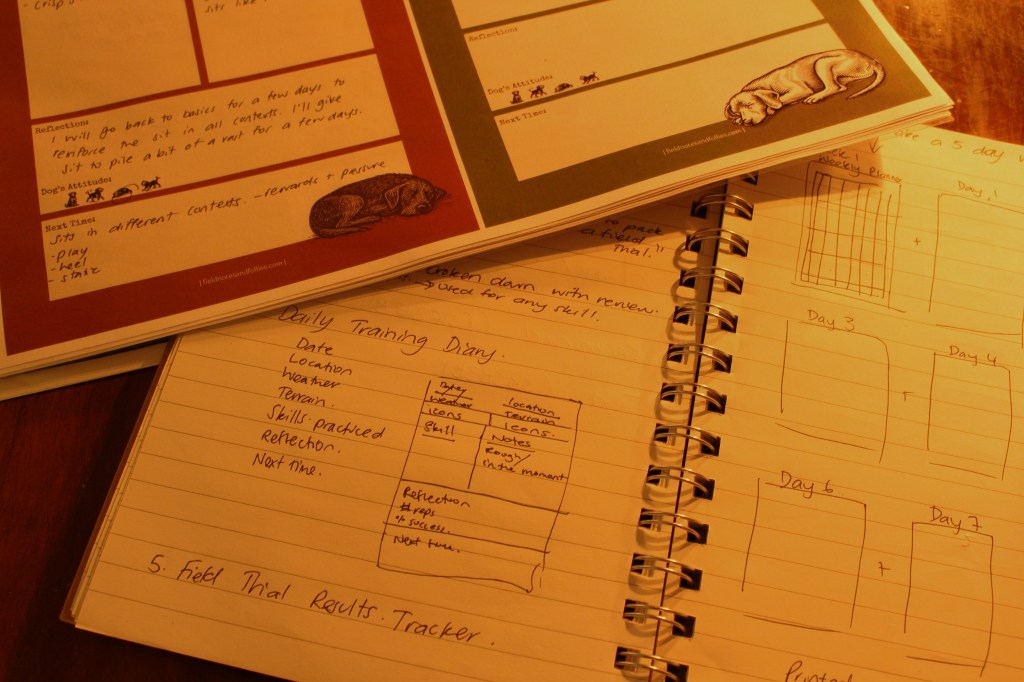
Just like all tools, a journal is only as good as the person wielding it. You can keep a journal poorly, like I used to, and it will be of very little use to you. Since I’ve changed how I’m keeping my training journal, I’ve noticed that I’m now capturing moments, not just metrics.
Keep it simple. I’ll admit, those beautifully hand-crafted works of art you see online are exquisite. But, if it’s too difficult to manage or maintain, you won’t stick with it. I’m not saying that your training diary has to be ugly to work, but if it’s lots of admin to keep going, it’ll die a death pretty quickly. Think about what you actually want to know about your training session. What are the most important things to record for the type of training you’re doing? It might be that you focus on three things per session. Start there and it can always evolve over time.
I’ve added more elements to my training diary as my training planning has grown. I started out with a weekly planner, to help me plan ahead and stay motivated. It gave me direction but, as I grew to enjoy the process, I felt I wanted more space to review each session. So, I added some daily training logs. Over the course of a few months, I took the time to think about what I wanted to know about each session and developed my own training sheets from there. I’m still tweaking them, but I now have something that’s functional and pretty enough to look at that I’m happy to share what the prototype looks like so far. It’s perfect for what I need, it’s detailed without being prescriptive and I can sub pages in and out as I see fit. Flexible and functional – bliss!
I’ve also learnt to cut myself some slack about filling the bloody thing in. As I write this, I still haven’t written up my notes from Thursdays session yet. I will, when I get a minute. But I’m not going to haul myself over the coals for having a full life. It’ll get done… later. Sure, filling it in after the session is ideal, but that’s just it. Ideal. Not essential. I’m also learning not to be a slave to the training diary. If I don’t have time to train because life happens, that’s ok, too. When I do train, my sessions are now more intentional than ever, so doing better training less often isn’t a big deal. I still aim to be consistent, I’m just not so militant about it.
Something else that helped me a lot was to remind myself to write like no one’s reading it. Admittedly, that’s a little harder to do at the moment knowing that I’m sharing the journey with you lot. But for the most part, no one else is going to read this stuff, so a scribble here, a spelling mistake there or an ‘oh, shit’ moment aren’t the be all and end all. It’s made me a lot more honest during my reflections, which has made me a more honest handler. A win, whichever way you look at it.
Give It a Go!
If you’ve never used a training journal before, I’d love for you to give it a go. Before you start, think clearly about what you want it to help you achieve. Begin small — maybe just three things you want to track from each session. If it’s working, build on it as you go.
And if the idea of starting from scratch feels daunting, join the Field Notes & Follies community — I’ll let you know as soon as our ready-made training planners and daily training pages are available, so you can hit the ground running.
However you choose to begin, remember: something small is always better than nothing at all.






Leave a comment