
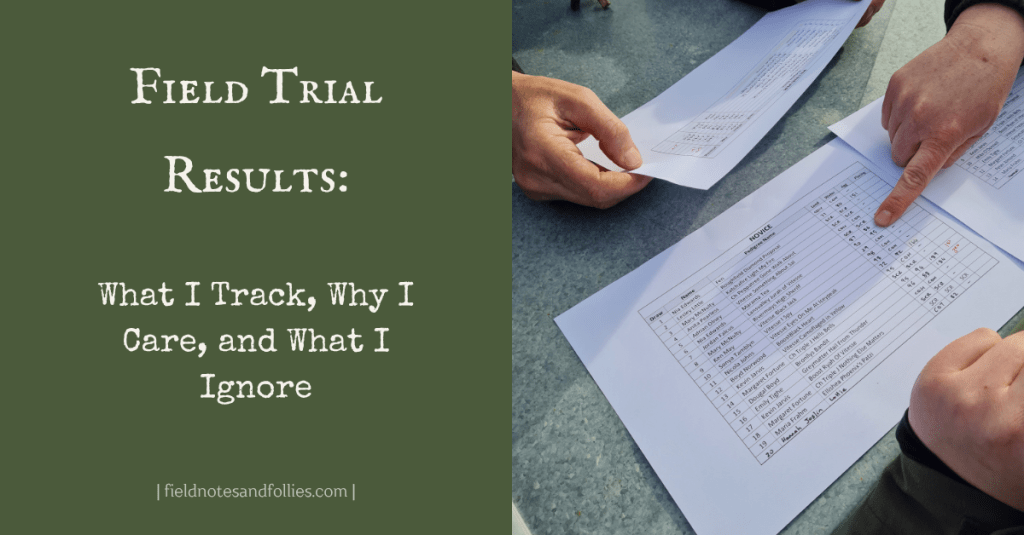

With a few months to go in the 2025 trialing season, I thought I’d talk about results. Hail and I have just completed the South Island Championships this weekend with some really pleasing results. Given that we haven’t got any ribbons, or a ‘placing’ to speak of, I thought this was the perfect time to talk about results and what they really mean.
Last week, I wrote about finding your level of competitiveness and using this to your competitive advantage. In short, identifying how competitive you are helps you to realistically guide your training program to match your expectations at field trials. What we didn’t talk about was the other half of that equation. That is, how tracking your competition results allows you to fully adapt your training program to meet those expectations.
Knowing what’s going well, and perhaps what’s not, is the only way to make constructive and intentional change to your training program. I’ve talked lots about tracking your training sessions, and I intend to have some helpful resources available soon to offer guidance through that process. But, we can’t forget that what happens at a trial is essentially the proof in the pudding. You might have smashed things in training, but do your trial results reflect all that hard work? And if not, why?
Here’s a look at what I track from our trial results, why I care about some things, and completely ignore others.
What I Track
To most of us, results typically mean scores, placings and rankings.
But, as most good athletes know (yes, the term athletes in this sense might be a bit of a stretch), scores are only part of the story. I agree that scores give you a good indication of technically how you went on the day compared to others, but often there is a lot more to a field trial than just the numbers at the end of the day.
I thought it’s worth nothing that most of what I’m tracking can be gleaned from a combination of looking at the results and thinking critically about our performance after coming of the peg. While we don’t typically get to see our score cards after a run, judges are often happy to chat to you about your run if you ask politely, at a convenient time, at the end of the day.
So, yes, I keep track of our final scores, but only to know where we lost points. Did we lose points at the peg, was it in the field work, was it all about the delivery?
I also break results down by section by looking at the aggregate scores, if we’re lucky enough to get that far in the competition. Did we have a great land section and a terrible water, or visa versa? If we didn’t get an aggregate score because we didn’t complete a section, why didn’t we finish? Did we have a disqualifying fault, did we run out of time, did I call it off, and if so, why?
With Hail, we often have pretty decent land scores and then we bomb out in the water section. I’ve been tracking this for some time now with pretty consistent outcomes in recent trials. This tells me that we need to work on water marks much more than we need to work on land marks in our training. Anecdotally, I knew that I didn’t train water work nearly as much as land stuff, but it’s been great having the data to support that inkling. To improve our scores in our water sections, I’m going to have to invest some serious time over the course of the summer to our water work. This will mean travelling to safe areas to practice our water entries.
Other less quantitative data I gather from our field trial results are things like how it felt on the peg. Was I nervous, did Hail seem focused or was her mind somewhere else. Did she listen to commands, did I maintain a consistent tone under pressure?
This information, picked out from our field trial results, directs my training strategy and goals for the next few months. That’s priceless training advice that you get for free! Why not make the most of it?
Why I Care
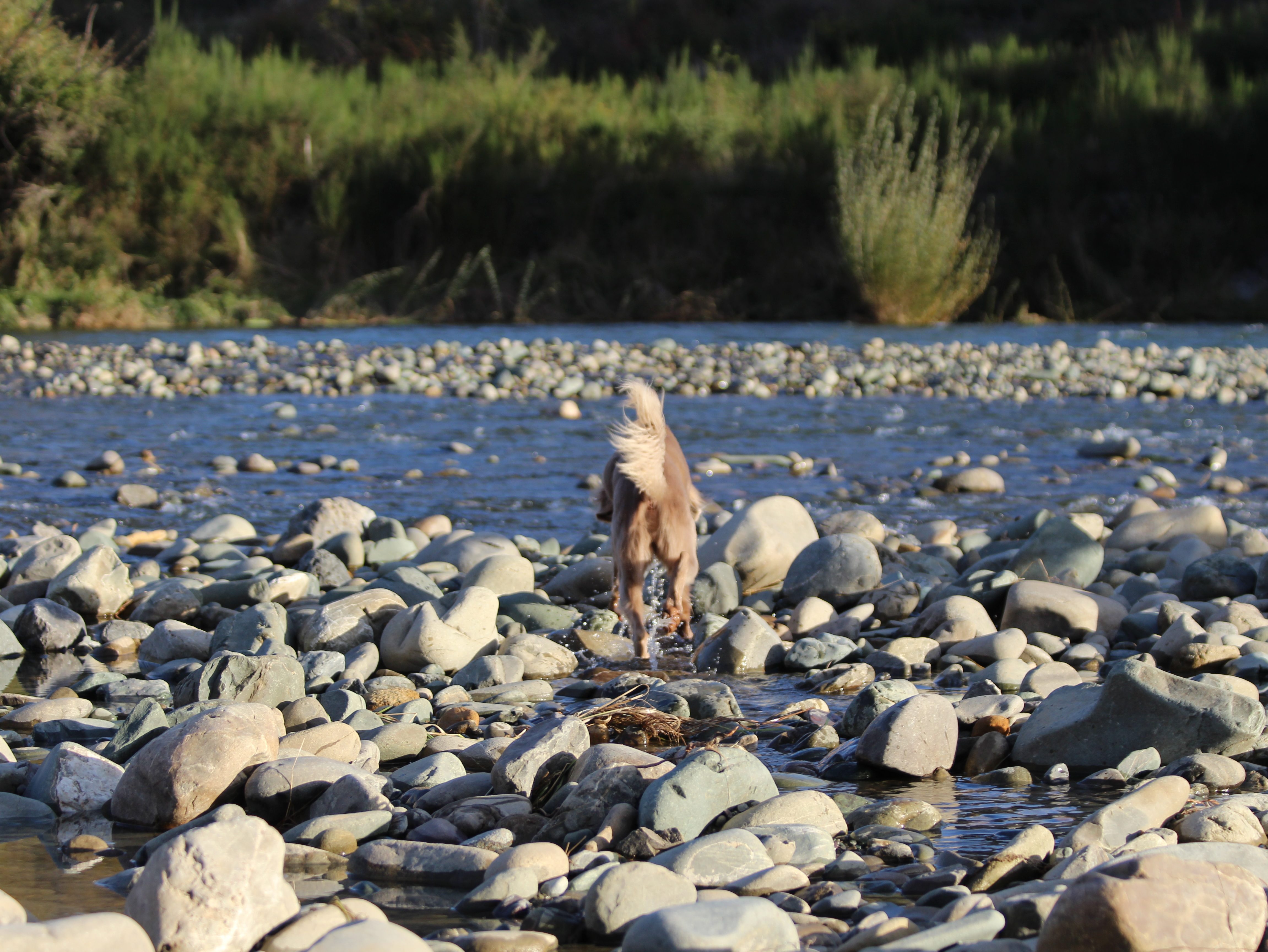
I’ve come to accept that I’m a competitive person. With that comes adjusting goals as we reach new levels of skill or tick off certain milestones in our trialling journey. Knowing how to adapt and improve is important to me because that’s ultimately what’s going to allow us to reach our next trialling goals.
Currently, our major trialling goal is that I’d like to see Hail win out of Novice. This won’t be easy, and I’m under no illusions that we’ve got some stiff competition to beat in order to get there. But, we won’t get there unless we train intentionally. A longer-term goal for us would be to see Hail complete an All Breeds before she retires in a few years time. Again, this is achievable, but not if we don’t make a plan for it.
As I’ve mentioned already, you can’t make meaningful changes to your training program if you don’t have a clue what needs changing. Results are the data points that very clearly tell us what has been working and what needs further refinement, or what needs to be taken right back to the drawing board in some cases.
I think it’s also important to highlight here that it’s often when we’ve had pretty horrific results that I’ve learnt the most. Sure, we all want to get to the stage where we’re only making minor adjustments to our training, but in the beginning that’s not usually the case. We have big issues to fix and it’s only when it goes horribly wrong at a trial that it forces you to do the deep thinking on that. It makes you seriously reflect and that usually starts with the question “Does my dog actually know how to do that? Have I explicitly taught them to do that thing under similar conditions?”.
There are lots of times I’ve come off the peg and been cross with myself for having asked Hail to do something in the field that we’ve only just starting learning in the rugby paddock. Or, there are times I assumed she’d do something in a trial but later realised that she didn’t because we’d skipped steps in the training of that skill.
What I Ignore
If I’m being honest, to me, placings mean sweet bugger all in the grand scheme of things. I get that this won’t be the same for everyone and here’s why.
If you’re an elite team, working at the top of your game, and trying to get your Field Trail or Grand Field Trail Championship title, placings really do matter. That’s because your skill-sets are already pretty well refined, and you’re at the top end of the competition spectrum. You’re a master, not an apprentice. This is when the game does become about chasing placings to earn those valuable challenge points to make up a champion.
If, however, you’re a beginner like Hail and I things are a little different. We’re at apprentice-level. Placings, especially in the minor events, shouldn’t be something you focus on. At this stage in our journey, we’re not trying to prove a point, we’re trying to learn the rules to the game we’ve started playing.
Like any good game of strategy, if you focus too much on the end goal, you lose sight of the real target and get lost in the noise. Sure, you might win a battle or two, but you’ll end up losing the war. Say you win a Novice, but if you’ve only focused on winning the Novice, and not on gaining the skills to consistently ace a Novice, you might end up in higher grades without any of the skill-sets you need to complete a Limit. Then you’re stuck playing catch up to other competitors that have focused on the long game, not the short one.
Along the same vein, I’ve seen dogs get incredible scores in a trial and end up with a 7th place. Likewise, on a different day, I’ve seen dogs with pretty average scores leaving with a win.
The key point I’m trying to make is that a placing only tells you how your dog ranked when compared with a set of dogs on any given day. As a standalone, sometimes a good placing can be a nice confirmation that you had a good day, but it’s not something that gives you much more information beyond that. It doesn’t give you any tangible work-ons or direct your training in a specific way.
So, if you’re new to this, do yourself a favour. Forget the placings. Instead, use the minors (Novice and Limit) like a more testing form of training. See trials as an opportunity to see how you and your dog cope under pressure, how you deal with scenarios that you haven’t set up, where you haven’t been able to control or limit all the factors. Trials are wonderful for exposing the things you need to include into your training program. Things that as a new handler, you’re unlikely to come up with off your own back.
What are you takeaways when the results come in? What things do you look for that I haven’t mentioned in this post? Please, share them with the rest of the Field Notes community in the comments below. We love hearing your thoughts.



 Field Notes & Follies
Leave a comment