
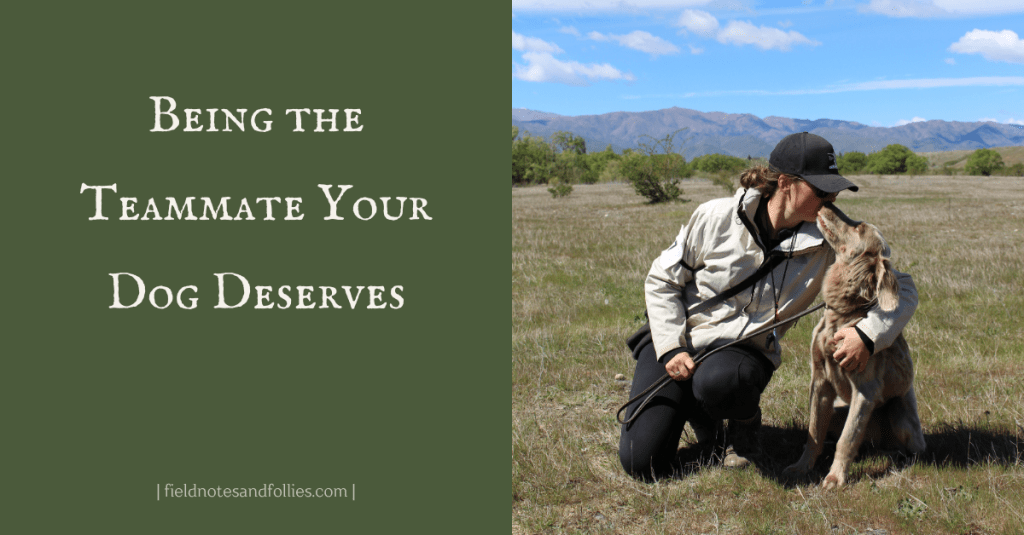
When we work with our dogs, in any given sport or discipline, there are plenty of things we need to think about. Handling requires us to consider multiple aspects of our dogs performance, our own performance and the changing nature of the environment we’re working in.
But what’s the most important thing we need to remember when we’re out working? What’s the one thing that would have the greatest impact on our dogs performance and our relationship together?
As promised, I thought I’d share another learning that I picked up from my time at the Kevin Cheff seminar. These little nuggets of gold have really changed the way that I view my training and my relationship with my dog. And they’re way too good to keep all to myself!
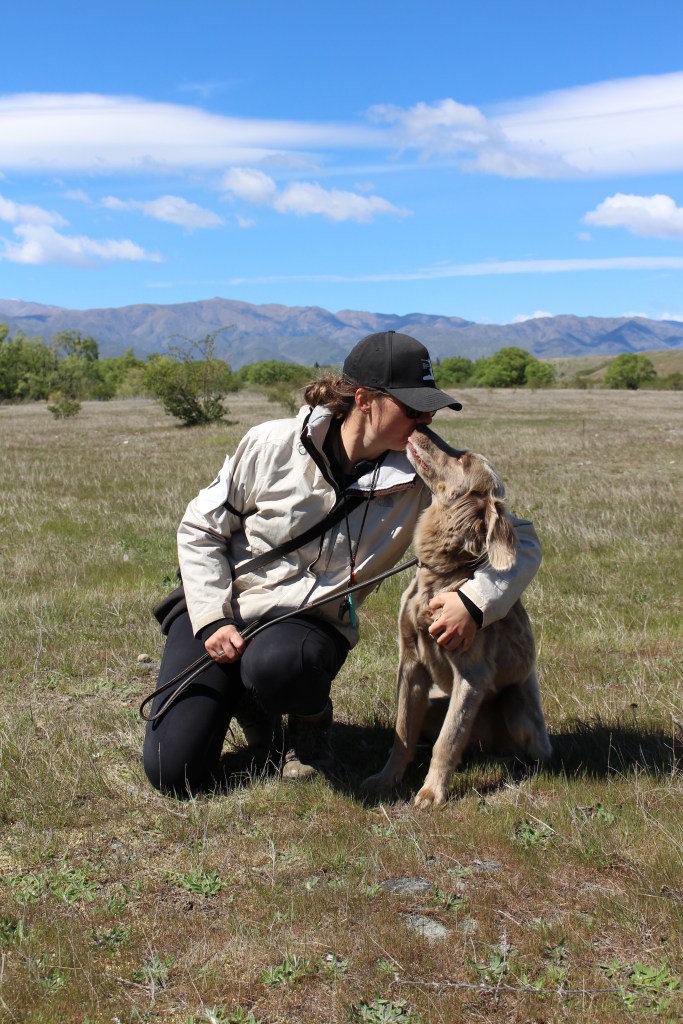
What Does it Mean to be a Teammate?
During our first day of the Fundamental workshop, Kevin made a casual comment that really stuck with me. So much so, that I wrote it down in my workshop notes with the full intention of sharing it with you.
The comment was something that sounds really obvious, but also something that I think we are all guilty of forgetting, or at least overlooking, on a far to frequent basis. The comment was about what it means to be a good teammate for your dog.
I didn’t write down exactly what he said, but the gist was that as a teammate, it is our job, as handlers, to help our dogs to get things right when they’re struggling.
It sounds so simple, but how many times have you got cross with your dog or put more pressure on your dog to perform when they aren’t getting things? How many times have you blamed your dog for a mistake in training or in the field, when they might have been really struggling with a concept that you hadn’t taken the time to teach them properly?
I say this because I am 100% guilty of this. I shudder to think of the times I’ve set Hail up to fail. And I feel awful about it!
I vow to be better from this moment forward.
How Can We Be Better Teammates?
Now that I am fully aware of my responsibility as a teammate, I think I’m in a much better position to make that happen.
But what does that really look like? How does an effective teammate show up in the world of dog sports?
Below is a list of things I’m now taking more seriously as a teammate to Hail. This isn’t by any means an exhaustive list, but it’s got me well on the way to becoming a better partner at the peg.
1. Assess all the time
As the person leading the session, I need to be constantly looking for feedback from Hail about how the session is going. I need to be assessing her state of mind, her success rate, and her understanding of the tasks I’m asking her to perform. This requires me to pause often and critically assess where we’re at as a team.
That’s harder to do than it sounds, and actually takes quite a bit of practice. It’s tempting to push through something that’s tricky or do just one more rep. Stop. Think about the outcome if it goes well, but also the potential outcomes if it doesn’t. Is it worth the risk? This is what assessing looks like. It takes time and practice to get good at it… and accept that you won’t always get it right. We don’t need to be perfect, but we do need more wins that failures.
2. Don’t take big leaps
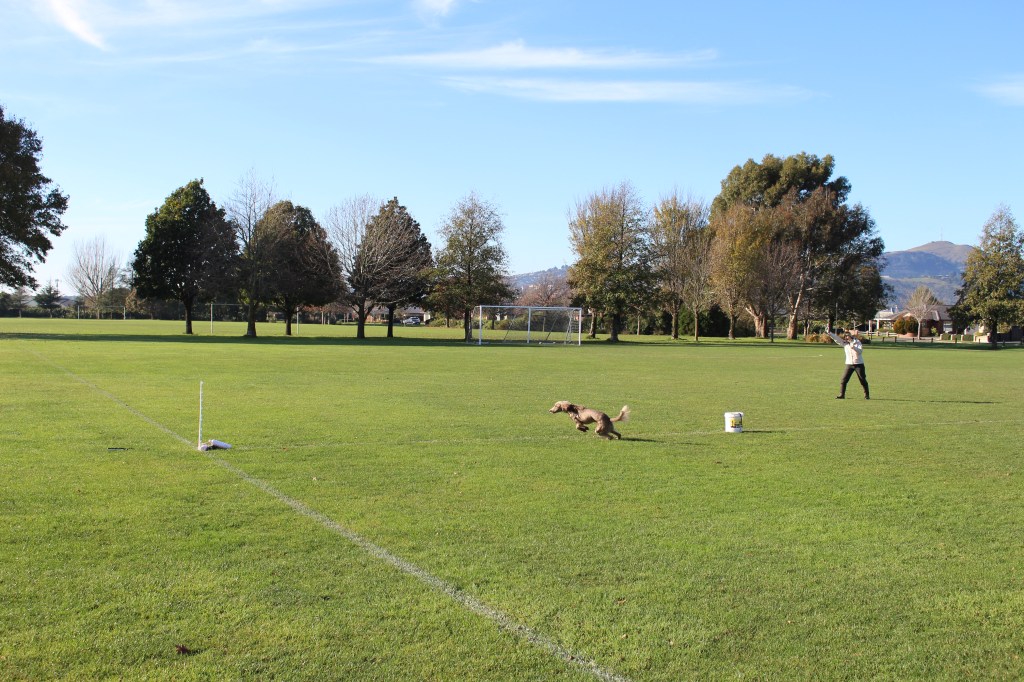
We’ve all been there. Your dog is doing well at something, so you get cocky and ask them to do something that’s well beyond their skill level… and surprise, surprise, they suck at it. Situations like this are disheartening for you (because you sort of knew it would happen, and now you feel like a dick because it did happen), but imagine how that feels for your dog.
Our dogs really want to please us. They can pick up on our frustrations and disappointments, even when we think we’re doing a good job of hiding them.
Do you both a favour, and stop jumping the gun with your training. Slow and steady wins the race. Take your time to work through all the steps of an exercise, even if you think it’s too easy. If that is the case, your dog will smash the steps, building their confidence and proficiency along the way. It might take you a few extra training sessions, but what you’ll gain will be well worth the effort.
If you choose to skip steps, you run the risk of missing out vital foundational work that will help to develop your dogs understanding of more complex behaviours later down the line. You also risk bruising their confidence if they find some steps too difficult, because they won’t have a full understanding of the foundations building up to what you’re asking them to do next.
3. Coach
Even if you stick to all the steps, building on the foundations layer by layer, there will still be times when your dog finds training challenging.
This is normal.
This is your opportunity to work on your relationship by coaching them through it. Show them that when they don’t know what to do, they can turn to you for help and guidance.
This doesn’t mean you have to give them the answer straight away. It just means that you might simplify the task slightly to see if they can apply what they know to a slightly different situation. It might be that you simplify back to the last point in time that they were successful. It might mean that you help them by showing them what to do to get it right.
Coaching can look like lots of things, but it’s always calm, collected, and intentional.
There is no place for frustration in coaching. If you find yourself going to that place, call it a day and go and make a cuppa.
4. Don’t assume they know
We’ve likely all heard someone say “They know how to do this” when their dog is not doing what they apprently know how to do… I have also said this about Hail in the past. This phrase is unhelpful and has no place in your repertoire if you are being a good teammate.
Generally speaking, if they aren’t doing it, chances are they don’t know it!
This is your sign that something has not connected for your dog, and you need to go back through your teaching sequence to figure out where the knowledge gap is. Your dog not doing something isn’t a failing of the dog, its a failing in the teaching sequence… and that responsibility lies with you.
5. Quit before the dog taps out
As I’ve mentioned in a few posts now, state of mind is everything. We need to be assessing this all the time. As a good teammate, it is our job to know when to end a session. We can end sessions for all sorts of reasons, but one that we need to be acutely aware of is when our dog is mentally, physically, and/or emotionally exhausted.
Each dog will have their own way of showing this, but as a general rule, there are a few things to look out for. I know that Hail is done when her tongue looks big and is hanging out of her mouth, even if she hasn’t been running much. Her eyes will be squinty and she has what I call the “thousand yard stare”.
Even if she looks like she’s keen to carry on, we stop at this point. Always.
If we carry on, I run the risk of her making mistakes out of exhaustion, and I’m always assessing her success and state of mind. Continuing past this point would negatively affect both of these.
How Do You Stack Up?
So, how do you stack up as a teammate for your dog? Do you do some, or all, of the things on my list? Are there things that I haven’t listed that you think are non-negotiables? Please share them in the comments below!



 Field Notes & Follies
Leave a comment